

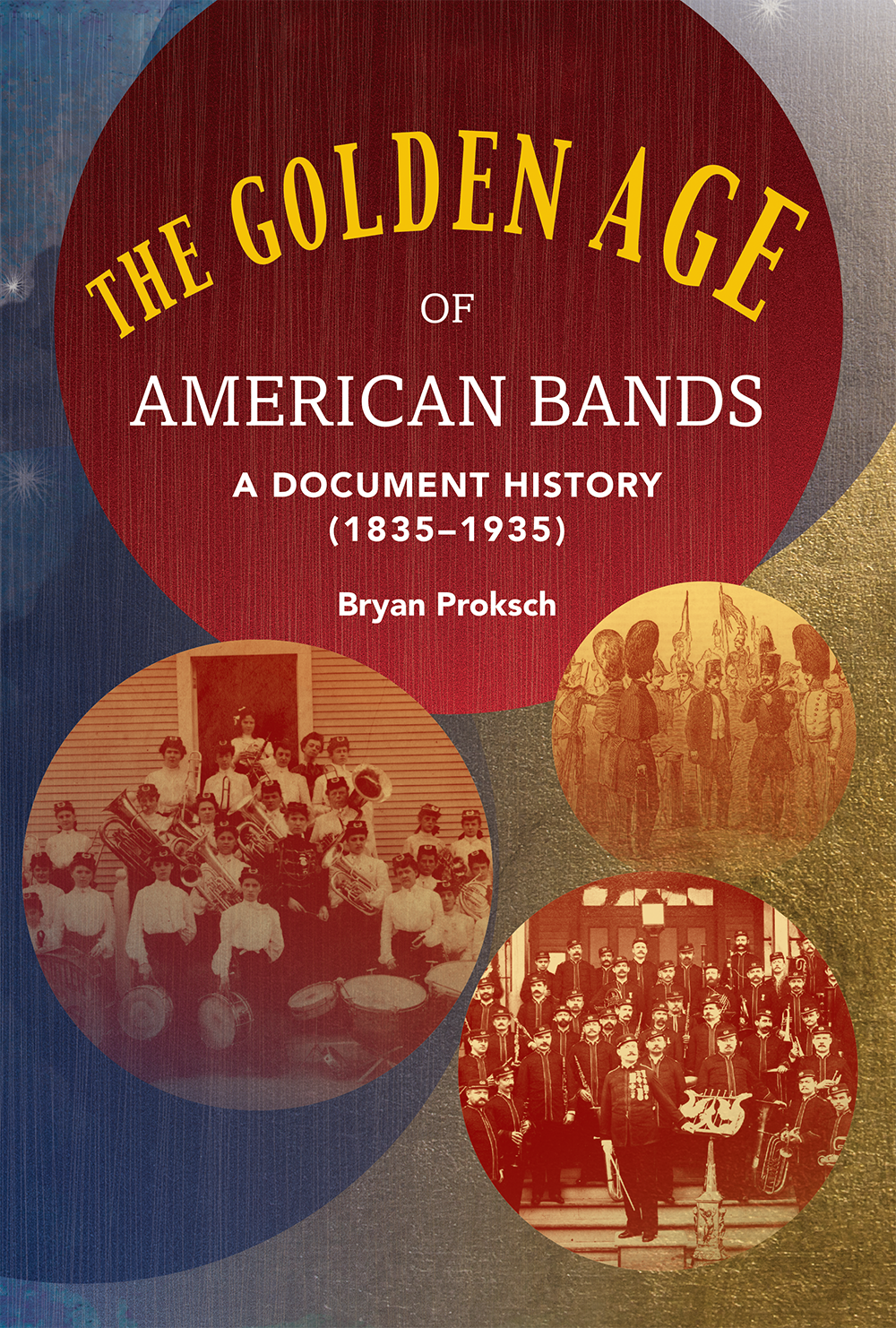
Cover Image
The Golden Age of American Bands
A Document History (1835-1935)
Bryan J. Proksch
- SKU: G-10368
Accompaniment - []
_x000D_
This is a fascinating and important book for everybody even remotely interested in the history of American bands. Bryan Proksch has done some painstakingly thorough research in putting together an amazing assemblage of documents… This is a must-have book!_x000D_
_x000D_
—Jon Ceander Mitchell_x000D_
The Wind Music Research Quarterly: Mitteilungsblatt der IGEB_x000D_
(March 2022), 14–15_x000D_
_x000D_
_x000D_
_x000D_
For the scholar, each entry presents an opportunity for expansion. For the teacher, this work provides source readings for courses on wind band history or for complementing Strunk or Weiss-Taruskin in university music history courses. That said, these documents stand as an enriching and entertaining read in their own right for anyone interested in the subject._x000D_
_x000D_
—Michael O’Connor_x000D_
Historic Brass Today 1/2 (Spring 2022), 32_x000D_
_x000D_
_x000D_
_x000D_
The Golden Age of American Bands is ideally suited for courses on the history and literature of bands in America. Indeed, this volume could suffice as a textbook for adventuresome teachers in that it touches on the major musicians, instruments, ensembles, and functions expected of such a course. . . . Both private and classroom band instructors will find compelling glimpses into the history of their craft. [It is] bursting with opportunities to inspire curiosity in their students while effectively supporting their own curricular goals._x000D_
_x000D_
—Benjamin D. Lawson and James A. Davis_x000D_
The Journal of Music History Pedagogy_x000D_
_x000D_
_x000D_
_x000D_
Proksch’s new collection of documents is a most welcome step in the direction of getting [the story of bands] under control. The juxtaposition of documents from so many levels and types of ensembles proves to have a cumulative effect: one begins to see the subtle and long-lasting connections among them despite the big differences. It is easy to envision it as a supplemental text in a course on band history and literature, but the book is also just an absorbing read. There is much to learn here, and much to enjoy._x000D_
_x000D_
—Ken Kreitner_x000D_
Notes 79/2 (December 2022): 217-218_x000D_
_x000D_
_x000D_
_x000D_
Proksch’s selection of material scripts a gripping first-person narrative of the evolution of bands in America. He blends valuable and relevant content with a prose-like approach that allows the reader to feel as if they are involved in the very conversations that occurred. The wide variety of perspectives represented . . . give the reader a full view of how bands came to be a significant piece of American culture._x000D_
_x000D_
—Eric Millard_x000D_
International Trumpet Guild Journal 47/3 (March 2023): 79–80_x000D_
_x000D_
_x000D_
This is the story of the American wind band, told chronologically by those who experienced it in real time from 1835 to 1935._x000D_
_x000D_
How did bands become bands? How did they rise in popularity? Which figures had insights and specific impacts on the development of the genre?_x000D_
_x000D_
Through source documents and articles, Bryan Proksch takes us on an extraordinary journey from the time of the first brass bands in the 1830s, through the Civil War and the golden ages of Gilmore and Sousa, to the cusp of the wind ensemble just before World War II._x000D_
_x000D_
Hear from a young Frederick Fennell about his efforts to create the first band at Eastman. Read the outline of Allessandro Liberati’s unpublished trumpet method book._x000D_
_x000D_
Eavesdrop on Karl L. King as he muses on the fate of bands after the death of Sousa. See Patrick Conway’s first undergraduate music education curriculum. Gawk as trombonist Fredrick Neil Innes embarrasses “world’s greatest cornetist” Jules Levy at Coney Island._x000D_
_x000D_
Explore as Alan Dodworth revolutionizes bands. Retreat with a military band in the middle of a Civil War battle. Find out what it felt like to sit in a Sousa Band rehearsal. Ask Herbert L. Clarke why he thinks you should be playing a cornet instead of a trumpet._x000D_
_x000D_
Find out how P. S. Gilmore managed to pull off the biggest concert events in American history._x000D_
_x000D_
The book includes numerous rare and unknown illustrations to show you the places where band history happened. The documents include rare periodical excerpts, handwritten letters, and other writings taken from archives throughout the United States._x000D_
_x000D_
These first-person accounts are certain to further refine and deepen our understanding and appreciation of American band history on a grand scale._x000D_
_x000D_
Contents:_x000D_
_x000D_
_x000D_
Beginnings (1835–1859)_x000D_
The Civil War (1860–1865)_x000D_
The Jubilees (1866–1879)_x000D_
The Gilded Age (1880–1896)_x000D_
The Band Age (1897–1914)_x000D_
World War I (1915–1919)_x000D_
Transition and Decline (1920–1935)_x000D_
_x000D_
_x000D_
_x000D_
_x000D_
Click here to download a FREE addenda._x000D_
_x000D_
Bryan Proksch is a distinguished faculty lecturer and associate professor of music history and literature at Lamar University in Beaumont, Texas. This is his third book. His A Sousa Reader: Essays, Interviews, and Clippings (GIA Publications, 2016) explores the documents relating to the life and career of John Philip Sousa.