

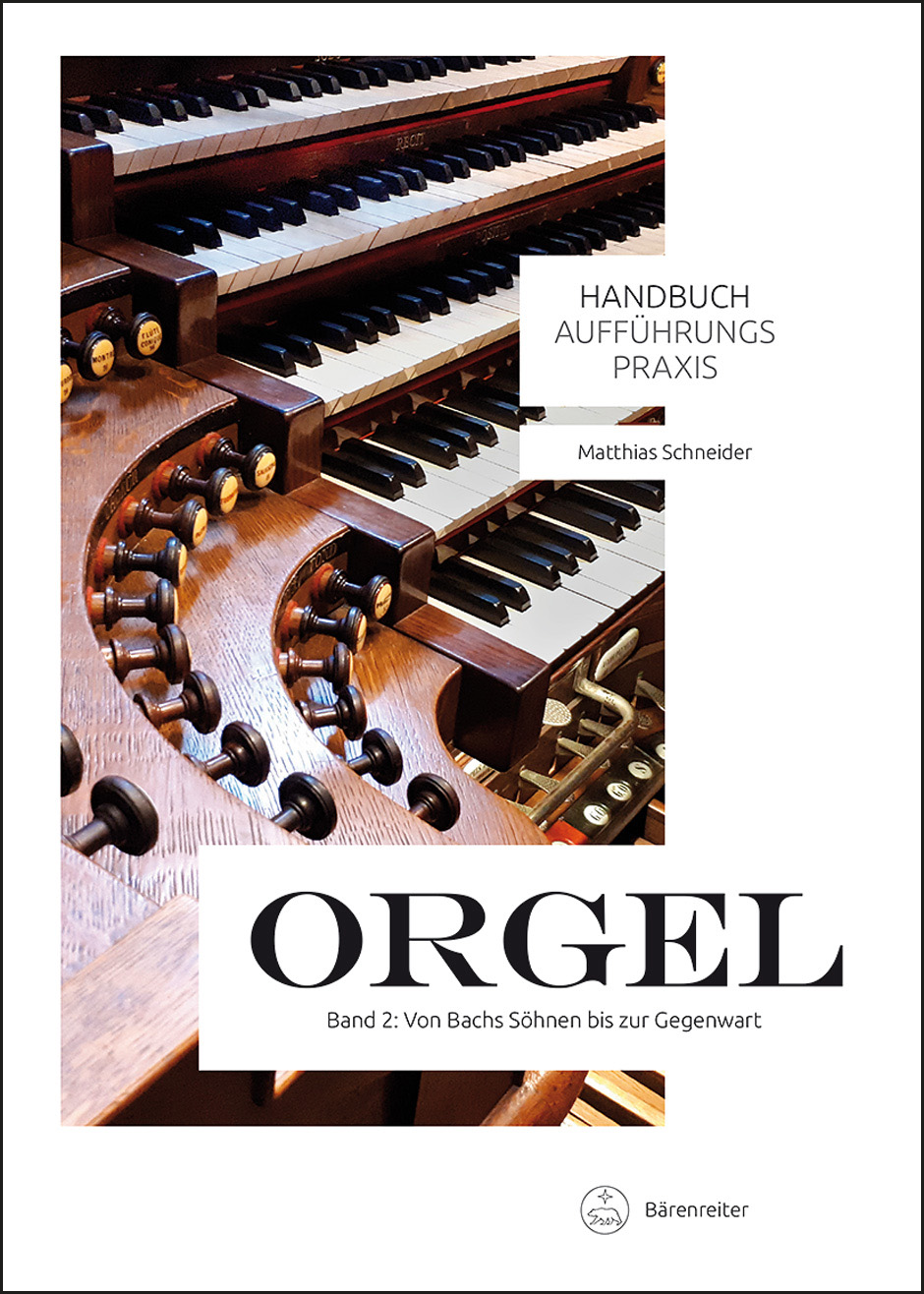
Handbuch Aufführungspraxis Orgel (Band 2) (Book)
Von Bachs Söhnen bis zur Gegenwart
Schneider, Matthias
Category: Instrumental
$100.00*
* Price is approximate. Learn more
Eine Kulturgeschichte der Popmusik (Book)
Jürgensen, Christoph / Kaiser, Gerhard
Category: Instrumental
Coproduction Metzler/Bärenreiter
$80.00*
* Price is approximate. Learn more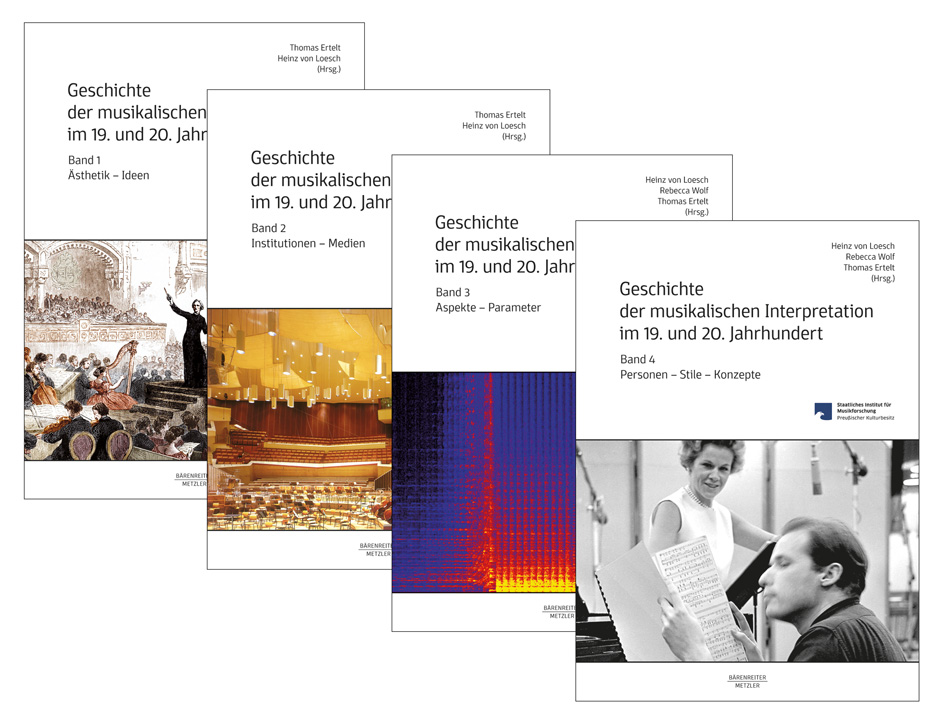
Geschichte der musikalischen Interpretation im 19. und 20. Jahrhundert (Volume 1-4) (Book)
Loesch, Heinz von / Wolf, Rebecca / Ertelt, Thomas
Category: Instrumental
Published on behalf of the Staatliche Instituts für Musikforschung Preußischer Kulturbesitz; Coproduction Bärenreiter/Metzler
$370.00*
* Price is approximate. Learn more
Easter Sonata for Piano (Performance score, Urtext edition)
Hensel, Fanny / Rolf, Marie
Category: Instrumental
$43.00*
* Price is approximate. Learn more
Etudes for Violoncello solo (Volume II) (Performance score)
from op. 35, 47, 54, 70, 90, 116, 120, 148, 155, 158
Dotzauer, Justus Johann Friedrich / Kennaway, George
Category: Instrumental
Friedrich Dotzauer (1783–1860) learned to play several instruments during his childhood but chose the cello as his main instrument because “only the violoncello evoked the unforgettable soulful alto voice of his dear mother” (Art. “Dotzauer”, Allgemeine Deutsche Biographie, 1877). Between 1829 and 1850 – his retirement as court musician in Dresden – he composed and published an extensive oeuvre of etudes for the cello.
For this second of three volumes, British cellist and musicologist George Kennaway compiled thirty of Dotzauer’s moderately difficult etudes – from the well-known “24 Capricci” op. 35, the “12 Exercices” op. 70 as well as the collections op. 47, 54, 90, 116, 120, 148, 155 and 158. In contrast to the first volume (BA12101), this collection also includes tenor and treble clefs, string crossings, double stops, thumb position and other advanced playing techniques.
$50.00*
* Price is approximate. Learn more
Sonata for Violoncello and Piano (Performance score)
after the Sonata for Violin and Piano
Janácek, Leoš / Bárta, Jirí
Category: Instrumental
Leoš Janáček’s only completed work for violoncello and piano is the “Fairy Tale” (BA09509). The arrangement of his violin sonata for violoncello provides cellists with another work by this composer – a valuable addition to the concert repertoire for this instrument. The arrangement was made by renowned Czech cellist Jiří Bárta, who recorded the version for the first time together with pianist Terezie Fialová (label Animal Music, 2024).
Bárta approached the arrangement with extraordinary sensitivity to Janáček’s original. The violin part remains largely unchanged, adapted only to accommodate the technical possibilities and timbre of the cello; in some passages, the cello even plays in the same register as the violin. For a particularly challenging passage in the fourth movement, the arranger offers an ossia alternative. The piano part is identical to the original, except for an octave transposition.
The musical text is based on the “Complete Critical Edition of the Works of Leoš Janáček”, E/1-2.
$41.00*
* Price is approximate. Learn more
Easy Piano Pieces and Dances (Performance score, Anthology)
Dvorak, Antonin / Víšek, Tomáš
Category: Instrumental
Although Antonín Dvořák left behind an extensive oeuvre for solo piano, young pianists and less advanced amateurs are usually introduced to the composer’s sound world through the same familiar works. However, in the shadow of these popular pieces lie many others that have been unjustly neglected or forgotten, but which, thanks to their modest technical difficulty, offer an ideal introduction to Dvořák’s piano music.
Editor Tomáš Víšek, himself an accomplished pianist, pedagogue and expert on Dvořák’s piano works, has selected ten appealing compositions from various creative periods of the composer’s life for this album. The collection includes both well-known, frequently played pieces – such as the dance miniatures “Two Little Pearls” – and almost unknown works like the untitled “Composition in G major”. The pieces are arranged progressively – from short and relatively easy pieces to more extensive and somewhat more demanding compositions.
$30.00*
* Price is approximate. Learn more
Forty Variations op. 3 (Performance score)
for Violoncello
Ševcík, Otakar / Jamník, Tomáš
Category: Instrumental
Ševcík's opus 3 which concentrates mainly on the use of the bouncing bow in violin playing, builds on the systematic development of bowing technique which the composer had already focused on in his previous opus 2 – School of Bowing Technique. In a compact and highly effective form, the “Forty Variations” cover a wide sequence of movements for the right arm ranging from elementary to virtuosic.
In his arrangement for violoncello, Tomáš Jamník stays true to Ševcík’s methodical intention by not mechanically transposing the original violin version, but rather ensuring an adequate adaptation to the positions of the violoncello. Thus, these short variations now become a valuable pedagogical work for cellists while also serving as virtuosic compositions for concert performances.
A transposition of the entire opus into thumb position is available in digital format: BA11624D.
$19.00*
* Price is approximate. Learn more
Songs I Low Voice (Performance score, Urtext edition)
Dvorak, Antonin / Hájek, Jonáš
Category: Instrumental
“Songs I” contains Dvorák’s first song compositions written from 1865 to 1882. This edition brings the project, which stretched over several years to publish Urtext editions of all the composer’s works for solo voice and piano, to a close.
Lesser-known songs by the young Dvorák are also included in this volume, of which the “Two Songs for Baritone” from the year 1865 appear here for the first time. The composer wrote these only a few months after “Cypresses”, his first work in this genre. Eleven songs of the cycle “Evening Songs” were published by various publishers during the composer’s lifetime; the ultimate song “Like the Moon in the Vault of Heaven” has not survived in its entirety and therefore appears in the appendix. In his early songs, the composer set not only texts by the leading Czech poets of his time to music, but also folk poetry.
The songs are presented in chronological order in volumes for high and low voice, each with underlaid vocal texts in three languages.
$65.00*
* Price is approximate. Learn more
Songs I High Voice (Performance score, Urtext edition)
Dvorak, Antonin / Hájek, Jonáš
Category: Instrumental
“Songs I” contains Dvorák’s first song compositions written from 1865 to 1882. This edition brings the project, which stretched over several years to publish Urtext editions of all the composer’s works for solo voice and piano, to a close.
Lesser-known songs by the young Dvorák are also included in this volume, of which the “Two Songs for Baritone” from the year 1865 appear here for the first time. The composer wrote these only a few months after “Cypresses”, his first work in this genre. Eleven songs of the cycle “Evening Songs” were published by various publishers during the composer’s lifetime; the ultimate song “Like the Moon in the Vault of Heaven” has not survived in its entirety and therefore appears in the appendix. In his early songs, the composer set not only texts by the leading Czech poets of his time to music, but also folk poetry.
The songs are presented in chronological order in volumes for high and low voice, each with underlaid vocal texts in three languages.
$65.00*
* Price is approximate. Learn more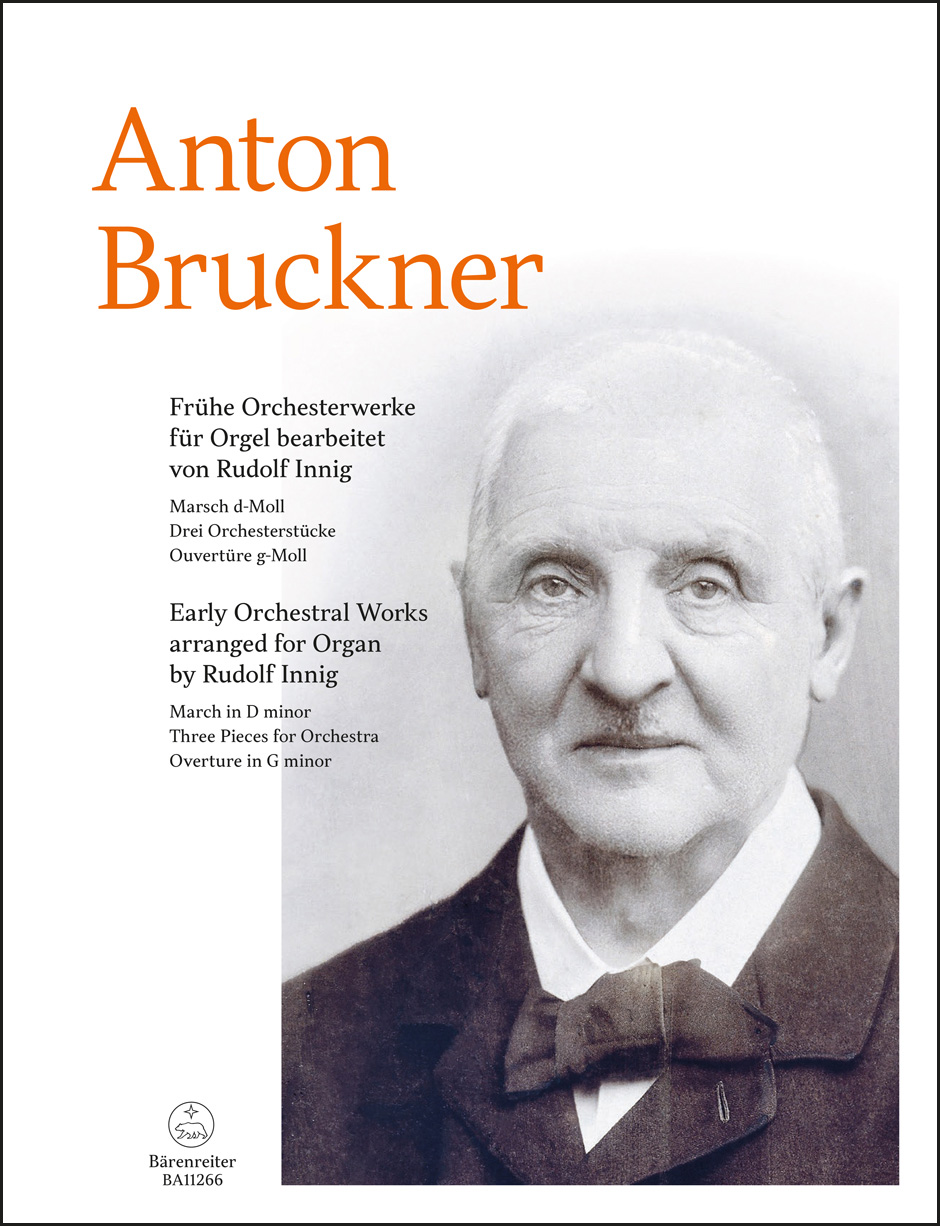
Early Orchestral Works (Performance score)
Arranged for Organ
Bruckner, Anton / Innig, Rudolf
Category: Instrumental
The early orchestral works of Anton Bruckner (1824–1896) clearly reveal the influence of his work as an organist. These compositions were written towards the end of his studies with Otto Kitzler, when Bruckner – already almost 40 years old – was still working as cathedral organist in Linz.
His organistic thinking is particularly evident in his treatment of the orchestral groups: he creates sound changes in blocks – similar to the way organ registers change. The motivic developments unfold in a quasiimprovised manner, often in the form of sequences, with terraced crescendos (manual changes) or strong dynamic contrasts, which are clearly separated from each other by general pauses (register changes). Against this background, Bruckner’s early orchestral works lend themselves particularly well for organ arrangements.
The transcriptions were performed by Rudolf Innig with great virtuosity and are available on the label Dabringhaus & Grimm Audiovision.
- Ideal for concerts or as an impressive conclusion to a church service
- Foreword (Ger/Eng) on the influence of Bruckner’s work as an organist on his early orchestral compositions
- A valuable addition to the small number of Bruckner’s organ works
$38.00*
* Price is approximate. Learn more
Sacred Motets by French Masters of the 19th and 20th Century for Solo Voice and Organ (Harmonium, Piano) (Score, Part)
Schauerte-Maubouet, Helga
Category: Instrumental
This anthology contains a selection of thirty sacred songs from Charles Gounod to Jehan Alain for solo voice with an organ (harmonium/piano) accompaniment. The collection is dedicated exclusively to French composers and can be used for both concerts and church services. The vocal works which are listed in chronological order represent a highly fascinating repertoire, that invites the study of the development of the solo motet genre. In addition to the 27 motets in Latin, the edition contains two French settings of the Lord’s Prayer as well as a vocalise. Well-known motets such as César Franck’s “Panis angelicus” or Gabriel Fauré’s “O salutaris” stand alongside previously unpublished works, including settings of the Lord’s Prayer by André Caplet and Émile Goué as well as the two motets “O salutaris” each with an additional instrumental part (violin, violin/ flute respectively) by Joseph-Ermend Bonnal, which are published here for the first time. Furthermore, long out-of-print pieces such as Eugène Gigout’s “Tota pulchra es” and Marcel Dupré’s “Memorare” are made available here again. In the Introduction (Ger/Fr/Eng), editor Helga Schauerte-Maubouet presents the musical sources and the historical context, and addresses questions of interpretation, such as the pronunciation of the Latin text. All Latin texts are provided with translations in three languages.
$70.00*
* Price is approximate. Learn more
Symphony in D major Hob. I:61 (Part - Violoncello, Double bass)
Haydn, Joseph / Stockmeier, Wolfgang
Category: Orchestra
Urtext from the G. Henle Complete Edition "Works of Joseph Haydn"
$29.00*
* Price is approximate. Learn more
Symphony in D major Hob. I:61 (Part - Viola)
Haydn, Joseph / Stockmeier, Wolfgang
Category: Orchestra
Urtext from the G. Henle Complete Edition "Works of Joseph Haydn"
$29.00*
* Price is approximate. Learn more
Symphony in D major Hob. I:61 (Part - 2. Violin)
Haydn, Joseph / Stockmeier, Wolfgang
Category: Orchestra
Urtext from the G. Henle Complete Edition "Works of Joseph Haydn"
$29.00*
* Price is approximate. Learn more
Symphony in D major Hob. I:61 (Part - 1. Violin)
Haydn, Joseph / Stockmeier, Wolfgang
Category: Orchestra
Urtext from the G. Henle Complete Edition "Works of Joseph Haydn"
$29.00*
* Price is approximate. Learn more
Symphony in D major Hob. I:61 (Wind set, Urtext edition)
Haydn, Joseph / Stockmeier, Wolfgang
Category: Orchestra
Urtext from the G. Henle Complete Edition "Works of Joseph Haydn"
$100.00*
* Price is approximate. Learn more
Symphony in D major Hob. I:61 (Score, Urtext edition)
Haydn, Joseph / Stockmeier, Wolfgang
Category: Orchestra
Urtext from the G. Henle Complete Edition "Works of Joseph Haydn"
$95.00*
* Price is approximate. Learn more
Sonata da Cimbalo for Harpsichord / Clavichord / Pianoforte / Piano in G major (Performance score, Urtext edition)
Martines, Marianna / Engel, Judith Valerie
Category: Instrumental
With notes on performance practice by Judith Valerie Engel
$21.00*
* Price is approximate. Learn more
Six Grandes Marches for Piano Four-hands op. 40 D 819 (Performance score, Urtext edition)
Schubert, Franz / Landon, Christa
Category: Piano
Notes on performance practice by Mario Aschauer
$50.00*
* Price is approximate. Learn more
Twelve Fantasias for Viola da Gamba without Bass TWV 40: 26–37 (Performance score)
arranged for Viola solo
Telemann, Georg Philipp / Galaganov, Misha
Category: Instrumental
Georg Philipp Telemann composed thirty-six fantasias for solo instruments: twelve each for transverse flute, violin and viola da gamba. Today the fantasias for flute and violin are among his most popular works. The fantasias for viola da gamba, on the other hand, have remained largely unknown until now – the only surviving copy of these works was rediscovered in 2015.
For this edition, violist Misha Galaganov has arranged the gamba fantasias for solo viola and in doing so, he has essentially retained the original musical text. For passages that lie outside the range of the viola – such as double stops and other multiple stops – he has found solutions that come as close as possible to Telemann’s compositional style.
A Foreword (Eng/Ger) and a detailed Commentary on readings and editorial issues (Eng) explain Galaganov’s approach to the arrangement and offer practical playing tips.
$46.00*
* Price is approximate. Learn more
Pièces de clavecin. Quatrième livre for Harpsichord (1730) (Performance score, Urtext edition)
Couperin, François / Herlin, Denis
Category: Instrumental
“French musicologist Denis Herlin, who mastered the harpsichord under the tutelage of keyboard legends such as Kenneth Gilbert and Huguette Dreyfus, once more presents an exemplary edition of a classic from the harpsichord repertoire. ... In the detailed Foreword ... Herlin explains the circumstances of composition, structure, ornamentation and also touches on the question of instruments. The musical notation is of delightful clarity ... The care that Couperin gave to the engraving of his ‘Pièces de clavecin’ is attested by the interspersed facsimiles of the first print, which lend this edition a bibliophile touch.”
(The Jury · German Music Edition Award 2017 · BA10844)
This Urtext edition of the “Quatrième livre” (1730) containing harpsichord pieces divided into eight ordres concludes Bärenreiter’s authoritative new edition of Couperin's “Pièces de clavecin”. For the first time, the editor has meticulously evaluated the many copies of the original print, most of which he unearthed himself in international libraries. All variants are recorded in detail in the Critical Commentary.
Numerous facsimile illustrations and the preservation of the original print’s essential features in a modern engraving offer today’s performers a fascinating insight into the unique sound world of this music. In addition to a detailed Introduction, this comprehensive edition offers notes on historical performance practice, an extensive glossary and Couperin’s “Explication des Agrémens, et des Signes” (each in Fr/Eng).
$95.00*
* Price is approximate. Learn more
Foundling Hospital Anthem HWV 268 (Choral score, Urtext edition)
1753 Version
Handel, George Frideric / Blaut, Stephan
Category: Choral
George Frideric Handel’s anthem “Blessed are they that consider the poor” was first performed in 1749 at a benefit concert for the Foundling Hospital orphanage and has since been known by this name. The vocal texts of the original four movements are taken from the Old and New Testaments (Book of Psalms, Prophets, Epistles of Paul). As is often the case with occasional works, the composer drew on music from earlier compositions in all movements – the fourth chorus, for example, is identical to the “Hallelujah” chorus from the “Messiah”. For a later performance in 1753, Handel substantially expanded the work by three movements and revised parts of the first version. This later version constitutes an independent and arguably more appealing version of the anthem.
This Urtext edition based on the “Halle Handel Edition” offers the first scholarly-critical edition of the musical text of the 1753 version.
$32.00*
* Price is approximate. Learn more
Foundling Hospital Anthem HWV 268 (Vocal Score, Urtext edition)
1753 Version
Handel, George Frideric / Köhs, Andreas / Blaut, Stephan
Category: Choral
George Frideric Handel’s anthem “Blessed are they that consider the poor” was first performed in 1749 at a benefit concert for the Foundling Hospital orphanage and has since been known by this name. The vocal texts of the original four movements are taken from the Old and New Testaments (Book of Psalms, Prophets, Epistles of Paul). As is often the case with occasional works, the composer drew on music from earlier compositions in all movements – the fourth chorus, for example, is identical to the “Hallelujah” chorus from the “Messiah”. For a later performance in 1753, Handel substantially expanded the work by three movements and revised parts of the first version. This later version constitutes an independent and arguably more appealing version of the anthem.
This Urtext edition based on the “Halle Handel Edition” offers the first scholarly-critical edition of the musical text of the 1753 version.
$38.00*
* Price is approximate. Learn more
Foundling Hospital Anthem HWV 268 (Part - Basses)
1753 Version
Handel, George Frideric / Blaut, Stephan
Category: Orchestra
$31.00*
* Price is approximate. Learn more